
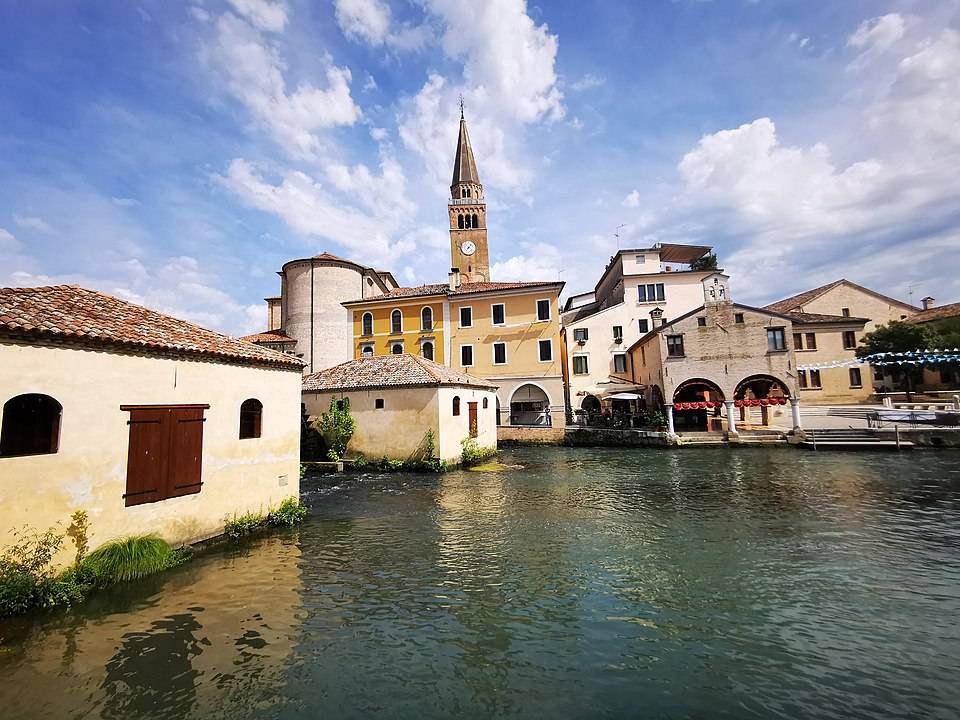
There is a place where time seems to have stood still, lulled by the murmur of spring waters and the elegance of architecture that speaks of a glorious past. Portogruaro, the “capital” of eastern Venice, is not just a historic village: it is a sensory experience that officially began in 1140, when Bishop Gervino decreed its birth on the banks of the Lemene River. For centuries, it was the “Gateway to the Spelt Route,” a vital commercial hub where goods from Northern Europe passed through on their way to the Serenissima, leaving behind a legacy of priceless beauty.
For us at Agriturismo Altrove, Portogruaro is the ideal retreat for those who, after a day spent in the silence of our countryside, want to immerse themselves in a refined and vibrant urban atmosphere, but one that is still marked by the slow pace of the river.
The charm of the historic center: between water and architecture
The historic center of Portogruaro has a characteristic “comb-like” layout, where every street seems to seek contact with the Lemene River, fed by clear springs that keep the water clear and alive.
The town hall square and its symbols
The heart of city life is Piazza della Repubblica. Here stands the Loggia Comunale (Town Hall), a 14th-century building with a Ghibelline façade. If you look closely at the base of the façade, you will notice five stone “testoni” (big heads): these are 16th-century sculptures from an ancient bridge over the river, a detail that few notice but which encapsulates the soul of the city. The side wings of the building, added in 1512, were constructed using ‘scrap material’ from the old castle. In the centre of the square stands the famous Pilacorte wellhead (1494), adorned with two bronze cranes.
But the real treat for history lovers lies right beneath your feet: beneath the pavement of the square, the remains of a 4th-century Basilica Apostolorum have been discovered, an early Christian site of rare beauty.
The mills on the Lemene
Crossing the loggia of the Pescheria, you will find yourself in front of the most iconic view: the 15th-century mills near the Sant’Andrea bridge. Once the beating heart of the milling industry, today they host exhibitions and cultural events, offering a poetic view of the incessantly flowing waters, mirroring the elegance of the surrounding buildings.
The arcaded streets: Corso Martiri and Via Seminario
Walking along Corso Martiri della Libertà and Via Seminario is like walking through an open-air art gallery.
- Palazzo Muschietti (now de Gotzen): Dating back to 1482, it is an architectural masterpiece famous for its refined four-light window.
- Palazzo Dal Moro: A splendid example of mixed Gothic-Renaissance style.
- Cathedral of Sant’Andrea: It houses works by Palma il Giovane and is flanked by the leaning bell tower, an unmistakable symbol of the city skyline.
An expert eye will notice that many porticoes use pointed arches. This is not just an aesthetic choice linked to Venetian Gothic taste, but a practical solution: the pointed arch allowed much more light to enter the mezzanine floor (the ‘mezà’), avoiding the deep shadows that a round arch would have cast on the small windows of the commercial offices.
Art and history: museums not to be missed
Portogruaro boasts roots that date back to Roman times, thanks to its proximity to the ancient Concordia Sagittaria.
- Concordia National Museum: Founded in 1885 thanks to the foresight of Dario Bertolini and the support of the famous archaeologist Giuseppe Fiorelli, it is a temple of classical memory. Here you can admire the Corneli stele-aedicule and the mosaic of the three heads. It is a must-see to understand the deep connection between Portogruaro and its ‘ancient mother’ Concordia. [Official Museum Website].
- Palaeontological Museum: Located in Palazzo Marzotto, it is surrounded by a beautiful public park, ideal for a refreshing break among fossil finds and centuries-old trees.
The city was also the birthplace of prominent figures such as Luigi Russolo, pioneer of musical futurism, and was home to Lorenzo Da Ponte, Mozart’s brilliant librettist, testifying to an unbroken cultural tradition.
Events and culture: what to do in Portogruaro
From winter to summer, Portogruaro comes alive with events and celebrations that have become established over the years, making it the symbol of a lively and welcoming north-east.
The Fair of Saint Andrew
During the last two weekends of November, Portogruaro hosts the Sant’Andrea Fair, one of the most important trade fairs in the Portogruaro area. It involves the whole city with food and wine traditions, local crafts, entertainment for young people and shows. The name, ‘Antica Fiera Mercato delle Oche e degli Stivali’ (Ancient Goose and Boot Market Fair), recalls the ancient market where geese and boots were the main items traded between farmers and podestà.
Lands of the Doges in Celebration
Maggio Portogruarese is famous for Terre dei Dogi in Festa, an event that draws thousands of visitors to the historic centre. Known as Festa dei Dogi, it celebrates Portogruaro’s Venetian origins and cultural influence from Venice. The focus is on food and wine from local producers.
The Bocolo Festival
Inspired by the Venetian festival of 25 April (St. Mark’s Day), the Festa del Bocolo celebrates the theme of the Bocolo and nature. It takes place on the Sunday before 25 April, from morning to evening, in the historic centre.
The International Music Festival
Established in 1983, the International Music Festival is held every year between August and September. A multifaceted event, it has made a name for itself on the music scene, attracting musicians, teachers, students and enthusiasts.
For a more accurate overview of upcoming events, we recommend visiting the Portogruaro Events website.
Local flavours: wine and tradition
After so much art, treat yourself to a break in one of the bacari (wine bars) in the town centre. Here, hospitality has the flavour of Lison DOCG, a refined white wine, and Refosco dal Peduncolo Rosso, the pride of the local wine production in Lison Pramaggiore. If you visit the city in November, don’t miss the Fiera di Sant’Andrea, the ancient festival of the patron saint, where the goose and boot market celebrates the rural roots and authentic flavours of our land.
How to reach Portogruaro from Agriturismo Altrove
Staying at Agriturismo Altrove in San Michele al Tagliamento means having the privilege of reaching Portogruaro in just a few minutes. We recommend enjoying the short journey along the rural roads: it is the perfect prelude to the relaxation you will find under the arcades of the town centre.
The city serves as the perfect centre point between our inland areas and the beaches of Bibione and Caorle, offering a high-level cultural break for those who wish to alternate between the sea and discovering history. Leaving your car behind and walking through the 13th-century walls is the best way to tune into the soul of this “little Venice”.
In conclusion
Portogruaro invites you to slow down, a place where the beauty of Venetian architecture meets the peacefulness of the springs. It is the perfect destination for those seeking an excursion full of meaning, history and authentic flavours, just a stone’s throw from the nature that surrounds our property.
Experience the magic of Portogruaro starting from an oasis of peace. Book your stay at Agriturismo Altrove. We will be happy to welcome you and guide you in discovering the hidden treasures of our territory, offering you personalised suggestions for an unforgettable experience combining relaxation and culture. Contact us today to plan your journey through time.


